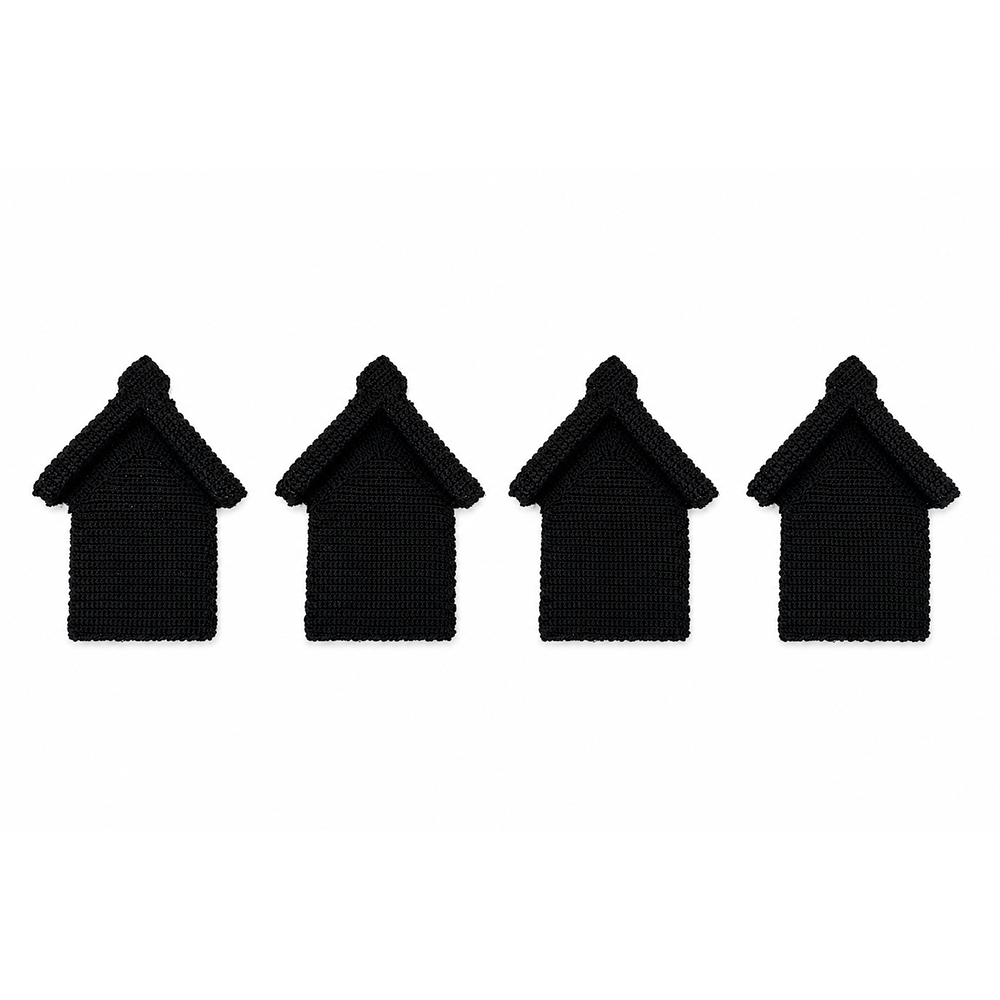
The houses in 'Home?' begin with another familiar form. A house can suggest shelter, belonging and safety, yet home can also be a place of restriction or unequal expectations. Covered in black crochet, the houses hold these possibilities together. The stitches appear to protect their surfaces, while the dark covering can also feel enclosing. Seen side by side, the houses invite viewers to consider how differently people experience the same idea of home. For women in particular, the home has long been both a place of care and a place where much necessary work remains unseen.
My work begins with objects that seem familiar: a house, a tool, a body. I am interested in what happens when their expected meanings become uncertain. Through sculpture and assemblage, I bring found objects together with fabric and thread, allowing one material to change how another is seen. Crochet is central to this process. It covers, connects, protects and sometimes confines. Its slow accumulation of stitches gives an object a new surface and asks us to look again at what lies beneath.
Crochet is often associated with women’s work in the home. I use it because that history remains visible in the material. The time needed to make something by hand is part of the work, although it cannot be measured at a glance. Each stitch records a small action; together, the stitches reveal the labour and patience behind a finished form. By bringing crochet into the exhibition space, I want to make that labour visible and question why skills practised in domestic life have so often been valued less than other forms of making.
Wrapping an object changes its relationship with the viewer. A hard surface becomes soft. A recognisable shape may remain, while its original purpose recedes. In my series Women Would Do It Differently, I crochet around objects associated with masculine power and aggression. The thread does not simply decorate them. It interrupts their familiar appearance and creates a tension between the object’s history and the care involved in covering it. That tension leaves room to imagine different responses to conflict and different ways of exercising power.
The houses in Home? begin with another familiar form. A house can suggest shelter, belonging and safety, yet home can also be a place of restriction or unequal expectations. Covered in black crochet, the houses hold these possibilities together. The stitches appear to protect their surfaces, while the dark covering can also feel enclosing. Seen side by side, the houses invite viewers to consider how differently people experience the same idea of home. For women in particular, the home has long been both a place of care and a place where much necessary work remains unseen.
Crochet allows me to work directly with this tension between care and constraint. A covering can keep something safe, but it can also limit what can be seen or done. I do not decide in advance which meaning a finished piece should carry. As I work, the thread responds to the shape beneath it, and the object resists the neatness of the stitch. The resulting surface bears the marks of that exchange. It may follow the object closely in one place and obscure it in another. I want viewers to notice these differences and to spend time with an object before deciding what it means.
These works are connected by transformation. Crochet changes the shape of an object gradually, stitch by stitch, but it also changes the pace at which I encounter it. Repetition allows me to stay with a question rather than settle it too quickly. I think about what is hidden, what is remembered and what becomes visible through sustained attention. My interest in psychoanalysis and feminist thought informs these questions, particularly the ways social expectations can become so familiar that they are difficult to recognise.
I hope viewers will move between the comfort of the crocheted surface and the uncertainty of what it covers. The works do not offer a single answer about gender, home or power. They hold open a space for looking: at an object, at the labour that transformed it, and at the assumptions we bring to it. For me, crochet is a way of making those assumptions tangible—and of suggesting that what has been given a fixed role can still become something else.