
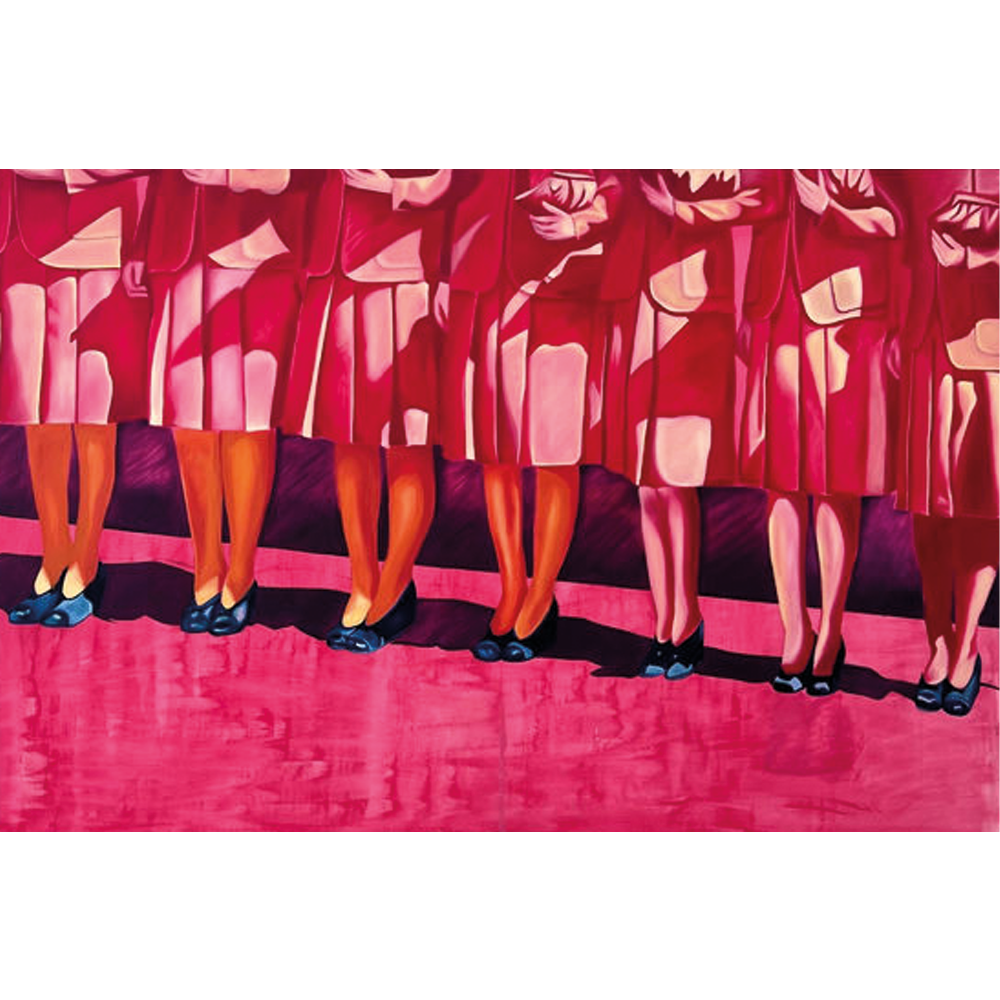
'Line Up' grew out of airline advertisements whose images of posed women resembled my prior research into cabaret culture. Removed from context, they became gestures, clothing and repeated forms, reimagined through the visual language of childhood. The colour palette draws on the 2003 version of Strawberry Shortcake, creating a playful, nostalgic surface. This innocence sits uneasily alongside the repetition and anonymity of the female figures. The work considers how representations of women absorbed during childhood are revisited from an adult perspective informed by the male gaze. 'Line Up' holds both perspectives together: the image as a child might have encountered it and that image understood differently by the adult looking back.
Gabriella Burns (B. 2001, Melbourne, Australia) graduated with First-Class Honours in Fine Art Painting from The Glasgow School of Art in 2025 and currently practices in Newcastle upon Tyne, UK.
Drawing on personal experience and memory, Burns’ practice explores female identity and the changing relationship between objectification and naivety across childhood, adolescence and womanhood. Burns is interested in the gradual and sometimes confusing process of becoming aware of misogyny and the sexualisation of women, and in how representations encountered during these formative years can shape our early understanding of femininity, identity and self-image. Looking back, she reimagines these representations through the perspective of her childhood self. She draws inspiration from the colour palettes of media that shaped her early experience, including Scooby-Doo and Strawberry Shortcake. Their Familiar, playful qualities introduce an apparent innocence that sits uneasily alongside the underlying subject matter. Burns’ paintings bring these different perspectives into the same image; she aims to simultaneously depict both how her childhood self might have understood these representations, inviting the viewer into the perspective of a young girl, and contrast this with the way the image can be understood later, through adult experience and an awareness of the male gaze. Her interest lies in the tension between these appreciations, and in what becomes visible when the same image is seen from different points in time.