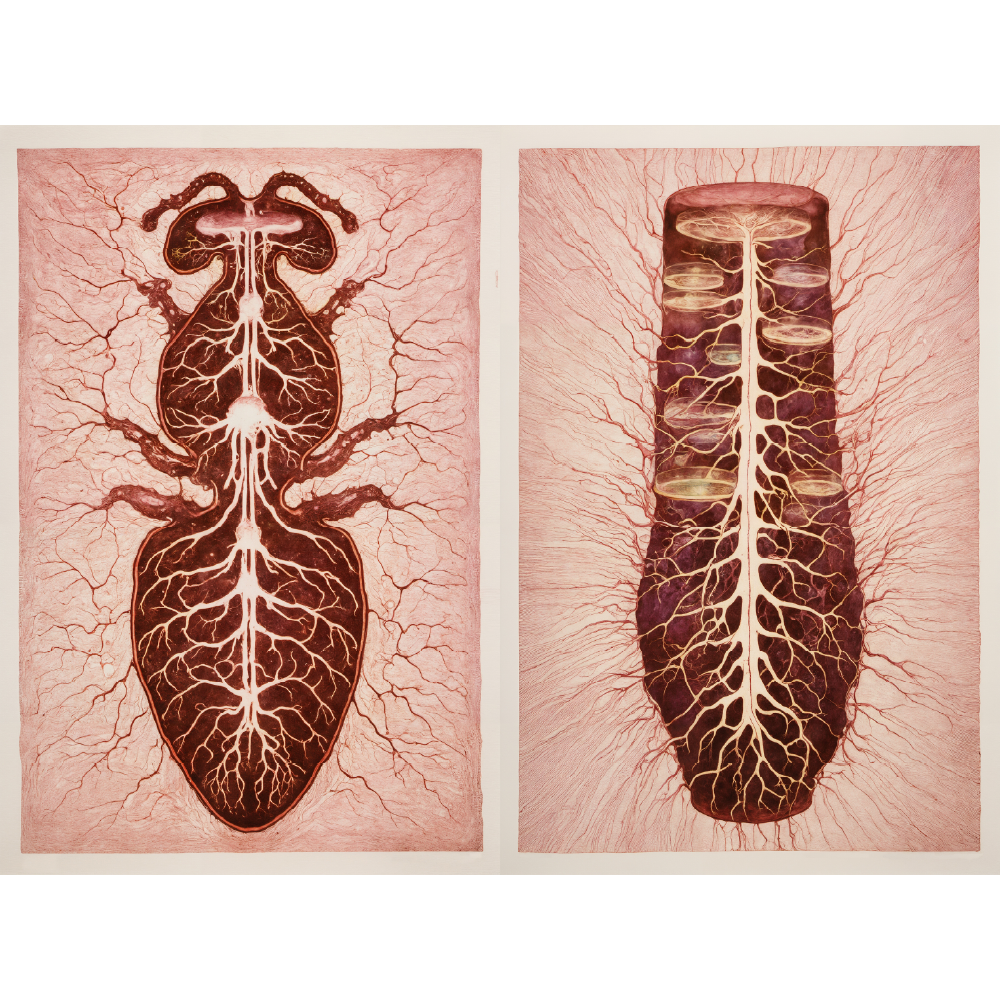
Bee Nervous System begins with an antique microscope slide, a preparation of the head nervous system of Apis mellifica made by the Paris preparateur Charles Bourgogne in the late nineteenth century. The specimen reaches the present already shaped by his decisions about what to dissect, what to stain and what to mount, and by the labels written in his hand. I come from a family of restorers of antiquities, and I approach a preparation of this age the way that background taught me to approach any inherited object, as something whose damage and choices are part of what it now carries.I photographed the slide through the microscope, then set what appears there against historical anatomical illustration and contemporary scientific imaging. None of the three agrees with the others. Those disagreements are what I cut into the copper. Across both plates the white nervous system rises through a dark body and branches into the red surface around it, loosening the boundary between organism and environment. One plate holds the whole body plan with the optic lobes at the top. The other opens the ventral cord into stacked sections, so the same structure appears twice under two incompatible conventions.Drypoint is slow and physically resistant, and the burr collapses after a few pulls, which keeps the hand present in what began as scientific observation. The work treats the bee's nervous system as another site from which the world is encountered, and offers perception as something that arises through sensory bodies quite unlike ours.
Andrea Abbatangelo is an Italian-British multidisciplinary artist based in London. Working across moving image, printmaking, microscopy, artificial intelligence, installation and sensory technologies, his practice investigates ecological intelligence and forms of perception beyond the human. His ongoing research explores pollinator cognition, interspecies relations and the ways computational systems reproduce human-centred assumptions. Abbatangelo holds an MA Fine Art: Digital from Central Saint Martins, University of the Arts London, where he graduated with Distinction and received a UAL Postgraduate Scholarship. Recent projects include presentations developed with Alias Studio and Serpentine Arts Technologies’ Future Art Ecosystems, a commission for Science Gallery Monterrey, and the continuing research platforms BeeVision and Náttura.